Software testing is at a very interesting juncture. While the traditional automation frameworks have proven their value in the industry over the years, there is something revolutionary coming up. AI isn’t a buzzword anymore and is now being implemented into numerous applications.AI is not just a phrase used at tech conferences anymore and is being used in many applications. It has developed into more of a formidable and self-reliant force.
Agentic AI is the next step – intelligent systems that think, adapt, and make decisions on their own. Quality assurance people who know and get that this is a game-changer will be the industry’s most promising leaders yet. With respect to the transformation, it is especially important for the individuals who are learning automation testing classes in contemporary institutes.
The main difference between agentic AI and traditional automation tools is that agentic AI can be self-servicing. Traditional scripts just perform fixed steps in an unchanged way, regardless of what is occurring. When interfaces change without warning, they break. Teams spend hours and hours updating test suites that have to be updated in a matter of weeks. The maintenance time required can also be quite high compared to the time saved due to automation.
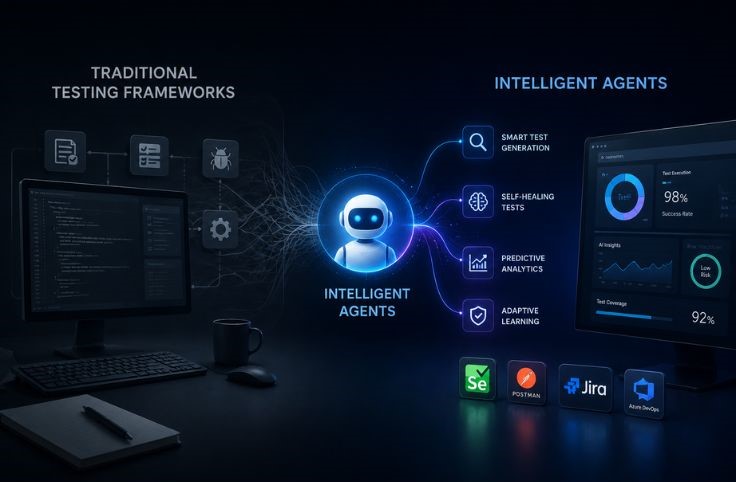
Intelligent agents work in a different manner. They see the behaviour of the app as a human will see it. The systems learn from past test runs and adapt strategies accordingly. When encountering unexpected changes, they don’t simply fail and stop. Rather, they think about what could be happening, look for other routes, and then test again. This capability changes the paradigm in development cycles for quality assurance and highlights how AI is changing software testing across industries.
Agentic Systems are capable of producing tests from natural language descriptions of application needs. Testers explain what needs to be validated without having to write complex code. These descriptions are automatically converted to detailed test cases by the AI agent. It can delve into edge cases that manual planning may not consider at all. Execution occurs in many environments at once, and no one is involved in it. Analysis of results is performed, anomalies are identified, and given contextual explanations.
When new features are added to the application, the automation scripts are broken. Agentic AI keeps an eye on these changes and fixes tests automatically. If the button changes its position or the name of a form field, the agent understands the equivalence. Fills in the locators and modifies validation logic without manual effort. This is a huge burden on the QA team’s maintenance costs. With these systems, organizations claim to reduce maintenance time as much as 70 percent. This is an intelligent defect analysis and prediction system. It is an intelligent system for defect analysis and prediction. Agentic systems not only discover bugs, but they also forecast where problems are going to manifest themselves. They examine the changes in code, patterns from defects in the past, and code complexity metrics collectively. Deeper testing is automatically performed on high-risk areas prior to issues entering production. If the defect is found, AI can give a detailed Root Cause Analysis (RCA).
Modern enterprises are increasingly exploring the agentic AI testing framework model to improve automation scalability and reduce repetitive maintenance tasks.
There is a reason why the traditional automation skills are still relevant. There is a reason why the traditional automation skills are still relevant. These achievements aside, there is still no doubt that essential knowledge is of the highest priority. It is important to understand how testing frameworks work to understand this context when using AI agents. Students of automation testing training acquire essential skills that are not replaceable by AI. To be able to guide intelligent systems, professionals need to know what good test coverage is.
A solid grasp of programming fundamentals helps testers to grasp the inner workings of AI agents. Unexpected decisions by agents will demand code and AI behaviour understanding for debugging. Whether the tests are designed by humans or by machines, they are based on the same principles of designing frameworks. Now, institutes providing automation testing courses for beginners in Vadodara are incorporating these concepts of AI along with the conventional testing education. This all-round method equips students with the necessary skills for the evolving needs of the industry. Graduates are familiar with traditional models and confidently adopt new smart technology.
It’s not that the future will be free of human testers as such. Rather, it’s cooperation, each bringing its own assets to the table. Humans are great at creative thinking, user psychology, and making judgments. Teams need to know both domains well to implement effectively. Testers develop testing strategies, and AI agents test them and optimize them. AI-generated information is analysed by humans, and decisions are made on important topics. This collaboration allows for greater productivity and is not a compromise on human insight, which is essential to good quality.
Many experts believe the future of QA automation will depend on balancing human expertise with intelligent AI-driven testing systems.
As AI shifts into the agentic mode, there are enormous opportunities for those who get ready. The demand for basic-level roles has risen significantly due to knowledge of AI-driven testing tools. The need for basic-level roles has grown considerably due to the knowledge of AI-assisted testing tools. Senior positions involve implementing and managing intelligent testing systems. The intuition to guide the use of AI effectively comes from working with real projects. Working on open-source testing projects showcases skills to prospective employers. One of the standout features is the creation of portfolios that feature the integration of AI with traditional automation.
Creating portfolios that feature traditional automation and AI integration stands out. By selecting the right software training institute in Vadodara to pursue training, you can make a significant difference in your career trajectory. The best education is offered by institutes that keep their courses up to date with the industry. The hands-on labs, real-world projects, and instructors help students learn so much faster. Career benefits last a lifetime from opportunities for networking with other students and industry professionals.
Agentic AI is a paradigm change in software testing. Intelligent agents add autonomous decision-making, self-healing properties, and predictive insights to the field of quality assurance. But this capability does not take the place of people and their skills in conventional automations.
back to blog